Thursday, February 17, 2005

Saturn's aurora defy scientists' expectations

PRESS RELEASE
Date Released: Thursday, February 17, 2005
Source: Space Telescope Science Institute

The dancing light of the auroras on Saturn behaves in ways different from how scientists have thought possible for the last 25 years. New research by a team of US and European planetary scientists led by John Clarke of Boston University, USA, has overturned theories about how Saturn's magnetic field behaves and how its auroras are generated. Their results will be published in the February 17 issue of the journal Nature.

By choreographing the instruments aboard the Earth- orbiting Hubble Space Telescope and the Cassini spacecraft, while it was en route to Saturn, to look at Saturn's southern polar region, Clarke and his team found that the planet's auroras - long thought of as a cross between those of Earth and Jupiter - are fundamentally unlike those observed on either of the other two planets. The lights that occasionally fill the sky over Saturn may, in fact, be a phenomenon unique within our solar system.

In Clarke's experiment, Hubble snapped ultraviolet pictures of Saturn's auroras over several weeks and Cassini recorded radio emissions from the same regions while measuring the solar wind, a stream of charged particles that trigger auroras. Those sets of measurements were combined to yield the most accurate glimpse yet of Saturn's auroras.

The observations showed that Saturn's auroras differ in character from day to day, as they do on Earth, moving around on some days and remaining stationary on others. But compared with Earth, where auroras last only about 10 minutes, Saturn's auroras can last for days.

The observations also indicated, surprisingly, that the solar wind may play a much larger role in Saturn's aurora than previously suspected. Hubble images, when combined with Cassini measurements of the solar wind, show that it is the pressure of the solar wind that appears to drive auroral storms on Saturn. In Earth's case, it is mainly the Sun's magnetic field, carried in the solar wind that drives auroral storms. In Saturn's case the orientation of the magnetic field plays no major role.

Seen from space, an aurora appears as a ring of light circling a planet's polar region, where magnetic poles typically reside. Auroral displays are initiated when charged particles in space collide with a planet's magnetic field and stream into the upper atmosphere. Collisions with gases in the planet's atmosphere produce flashes of glowing energy in the form of light and radio waves.

Scientists had long believed Saturn's auroras possess properties akin to both Earth and Jupiter. Like Earth's, they were thought to be influenced by the solar wind. Like Jupiter's, they were assumed to be influenced by a ring of ions and charged particles encircling the planet. The new results do show, however, a feature of Saturn's aurora that matches Earth's: Radio waves appear to be tied to the brightest auroral spots. This similarity suggests that the physical processes that generate these radio waves is just like those of Earth.

But, as the team observed, though Saturn's auroras do share characteristics with the other planets, they are fundamentally unlike those on either Earth or Jupiter. When Saturn's auroras become brighter (and thus more powerful), the ring of energy encircling the pole shrinks in diameter. When Earth's auroras become brighter, the polar region for several minutes is filled with light. Then the ring of light dims and begins to expand. Jupiter's auroras, however, are only weakly influenced by the solar wind, becoming brighter about once a month, at the most, in response to solar wind changes. Recent model work has suggested that the key feature that make Saturn's magnetic environment special, is Saturn's strong magnetic field that works together with a dominating process where the magnetic field lines break and re-connect with other lines.

Saturn's auroral displays also become brighter on the sector of the planet where night turns to day as the storms increase in intensity, unlike either of the other two planets. The new images also confirm that, at certain times, Saturn's auroral ring was more like a spiral, its ends not connected as the energy storm circled the pole.

Now that Cassini has entered orbit around Saturn, Clarke and his team will be able to take a more direct look at the how the planet's auroras are generated. The team is planning to probe how the Sun's magnetic field may fuel Saturn's auroras and what role the solar wind may play.

Saturday, February 12, 2005

Review of Being Julia

The past few days have been super busy for me, more than usual...

I saw Being Julia on Wednesday. I thought it was almost a great movie. I thought the actors did a great job, which I was expecting, especially with Annette Bening. Although given the cast the movie has the makings of being an especially great award sweeping movie, it doesn't cut it. I think the wrong pieces were left on the cutting room floor. Certain scenes ran too short. Others that should have been combined into one were split into a fragmented view of the story, which reduced the impact of some of the more powerful ideas and advances in the plot. The skill of conveying who Bening's character was in a superiorly subtle way as a thread throughout was completely undermined towards the very end of the movie when she has a discussion with her son, who explains it to her - very disappointing to hear it put so plainly after it had been so perfectly conveyed, because it took away from the effect. The movie was just OK, with the potential to be great.

Wednesday, February 09, 2005

NASA Cassini Spacecraft Witnesses Saturn's Blues

STATUS REPORT
Date Released: Tuesday, February 08, 2005
Source: Jet Propulsion Laboratory
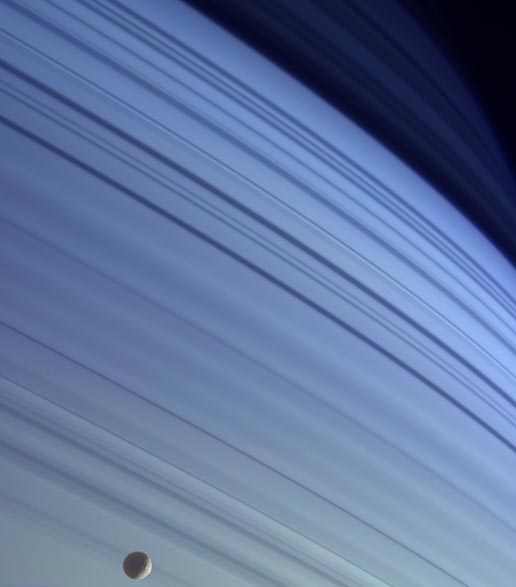
NASA Cassini Image: Mimas Blues

Mimas drifts along in its orbit against the azure backdrop of Saturn's northern latitudes in this true color view. The long, dark lines on the atmosphere are shadows cast by the planet's rings.

Saturn's northern hemisphere is presently relatively cloud-free, and rays of sunlight take a long path through the atmosphere. This results in sunlight being scattered at shorter (bluer) wavelengths, thus giving the northernmost latitudes their bluish appearance at visible wavelengths.

At the bottom, craters on icy Mimas (398 kilometers, or 247 miles across) give the moon a dimpled appearance.


Images taken using infrared (930 nanometers), green (568 nanometers) and ultraviolet (338 nanometers) spectral filters were combined. The colors have been adjusted to match closely what the scene would look like in natural color. See http://www.nasa.gov/mission_pages/cassini/multimedia/pia06142.html for a similar view in natural color.

The images were obtained using the Cassini spacecraft narrow angle camera on Jan. 18, 2005, at a distance of approximately 1.4 million kilometers (870,000 miles) from Saturn. Resolution in the image is 8.5 kilometers (5.3 miles) per pixel on Saturn and 7.5 kilometers (4.7 miles) per pixel on Mimas. The image has been contrast-enhanced to aid visibility.

The Cassini-Huygens mission is a cooperative project of NASA, the European Space Agency and the Italian Space Agency. The Jet Propulsion Laboratory, a division of the California Institute of Technology in Pasadena, manages the mission for NASA's Science Mission Directorate, Washington, D.C. The Cassini orbiter and its two onboard cameras were designed, developed and assembled at JPL. The imaging team is based at the Space Science Institute, Boulder, Colo.

For more information about the Cassini-Huygens mission visit http://saturn.jpl.nasa.gov . For images visit the Cassini imaging team home page http://ciclops.org.

Credit: NASA/JPL/Space Science Institute

Monday, February 07, 2005

A Quote for a Hectic Monday

To find the universal elements enough; to find the air and the water exhilarating; to be refreshed by a morning walk or an evening saunter... to be thrilled by the stars at night; to be elated over a bird's nest or a wildflower in spring - these are some of the rewards of the simple life.

- John Burroughs, naturalist and writer (1837-1921)

Saturday, February 05, 2005

Review of a Foreign Film - Black

Last night, after much ado about selecting a movie everyone was willing to see and after I suggested we see something "funny and lighthearted" (which everyone was in the mood for), we couldn't make a choice and so settled on an ambiguously titled film that's not rated, has no description in the moviefone listings, and was just a, well, plain mystery. The movie is called Black.

Luckily for me, Dave, and Tal - the foreign film fans of the group - the film turned out to be a Hindi film with English subtitles. I'm a Bollywood fan, despite the fact that musicals aren't particularly my genre. The movie Black is definitely not a musical. Within the first 15 seconds of the movie, I took out my mini-Kleenex pack and got ready for what I was sure was going to be a tear-jerker. Good call - the tissues came in handy... even for the "macho man" of our group (tears dried up yet Johnny?)

Anyway, the movie stars Amitabh Bachchan, who's absolutely brilliant as always, and Rani Mukherjee, who in this film did an outstanding job for such a difficult role. The movie was a little over 2 hours, which for a sad movie, can be hard to get through. But the movie was so well made - from the cast to the cinematography to every last detail, that the time flew. This movie really commands the audience's attention and committs them from the beginning to the end.

So that was the movie.

Between the time we bought our tickets and went into the theatre, we had about an hour to kill, so we walked to the Sports Chalet and spent some time there. The guys argued over who could lift more weights while us girls browsed the colorful pilates and yoga equipment. Afterwards, we went next door to this huge no-name discount bookstore. To my disappointment, they had absolutely no art books, but I was happy to find that they had a great poetry section. I couldn't resist, I picked up a copy of June-tree. Tal (the girl for whom dating is like an extreme sport) bought a copy of a how to find the perfect man book. Tal... LOL

Thursday, February 03, 2005

Light Continues to Echo Three Years After Stellar Outburst

PRESS RELEASE
Date Released: Thursday, February 03, 2005
Source: Space Telescope Science Institute

The Hubble Space Telescope's latest image of the star V838 Monocerotis (V838 Mon) reveals dramatic changes in the illumination of surrounding dusty cloud structures. The effect, called a light echo, has been unveiling never-before-seen dust patterns ever since the star suddenly brightened for several weeks in early 2002.

The illumination of interstellar dust comes from the red supergiant star at the middle of the image, which gave off a pulse of light three years ago, somewhat similar to setting off a flashbulb in a darkened room. The dust surrounding V838 Mon may have been ejected from the star during a previous explosion, similar to the 2002 event.


The echoing of light through space is similar to the echoing of sound through air. As light from the stellar explosion continues to propagate outwards, different parts of the surrounding dust are illuminated, just as a sound echo bounces off of objects near the source, and later, objects further from the source. Eventually, when light from the back side of the nebula begins to arrive, the light echo will give the illusion of contracting, and finally it will disappear.

V838 Mon is located about 20,000 light-years away from Earth in the direction of the constellation Monoceros, placing the star at the outer edge of our Milky Way galaxy. The Hubble telescope has imaged V838 Mon and its light echo several times since the star's outburst. Each time Hubble observes the event, different thin sections of the dust are seen as the pulse of illumination continues to expand away from the star at the speed of light, producing a constantly changing appearance. During the outburst event whose light reached Earth in 2002, the normally faint star suddenly brightened, becoming 600,000 times more luminous than our Sun.

The new image of V838 Mon, taken with Hubble's Advanced Camera for Surveys, was prepared from images obtained through filters that isolate blue, green, and infrared light. These images have been combined to produce a full-colour picture that approximates the true colours of the light echo and the very red star near the centre.

Wednesday, February 02, 2005

Arctic National Wildlife Refuge

New interest for saving the Arctic National Wildlife Refuge seems to have recently been sparked... For everyone who's been asking, here's the link to the petition again:

http://www.sierraclub.com/petition/arctic/

We're also currently trying to organize another Oil on Ice event. If you'd like to take part, send an email.

Tuesday, February 01, 2005

The Meaning of This Blog

This blog's been in and out of consciousness quite a bit. Those of you who've complained as to why it doesn't get updated more often or why the juicy details and *expanded view of things with a touch of satirical sarchasm* about key events haven't been included have seen this blog go brain dead - and then the comeback which so far has been nothing.

After all that time of anticipating the bit of spare time I'd have to start blogging and shortly after I started blogging, I've discovered that I have absolutely no idea as to what the meaning of this blog is.

Is it to share thoughts and ideas that are easier to share in writing than by just talking? Is it the appeal of sharing thoughts with perfect strangers and friends at the same time?

I'm definitely not anonymous here. People have my blog address in their little pdas - true, I'm at fault for mentioning that I started the blog in the first place (it's just that I was so excited!) but the fact is it's out there.

When I first starting making entries in it's pre- brain dead existence, I promised myself I would try to make non-mundane posts only. That didn't happen.

the hard place: all things in my life that aren't exciting are mundane
the rock: exciting things are usually too exciting to share with the whole world and my poor blog is caught in between - *sigh* the hard place, the rock...

ok, so after giving the whole meaning of the blog some thought, I think I'm gonna try to make it like a personal journal and commentary about things I find interesting. I'm sure it'll get personal, so fair warning there ;-) And all this just means that I'm where I started, except now I'm consciously there.

So, here goes...

Site Meter
Blogarama - The Blog Directory
Promote your blog for free.